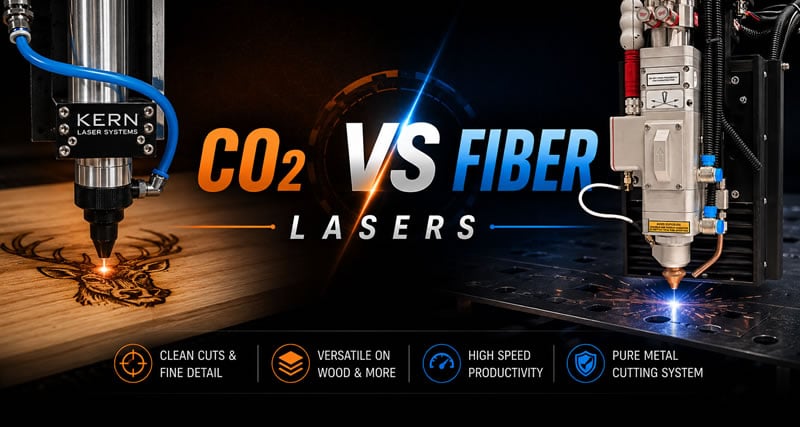
Industrial manufacturing is undergoing a rapid technological shift. According to recent industry analyses, fiber laser adoption has grown by more than 20% annually in recent years, driven by the demand for higher throughput and lower operating costs in metal fabrication. But does this growing trend mean fiber is the right choice for every manufacturer? Not necessarily. Understanding the fundamental differences between CO₂ and fiber laser cutting systems is essential for business owners and engineers making capital investment decisions that will impact productivity, operating costs, and long-term profitability.
Fundamental Differences in Technology
To make an informed decision, one must first understand the core mechanics of each system. CO₂ lasers are gas lasers that use a mixture of carbon dioxide, nitrogen, helium and other gases to generate a beam. This beam is typically directed via mirrors and lenses to the workpiece. In contrast, fiber lasers are solid-state lasers that use doped optical fibers to amplify the beam. This fundamental difference dictates their performance characteristics.
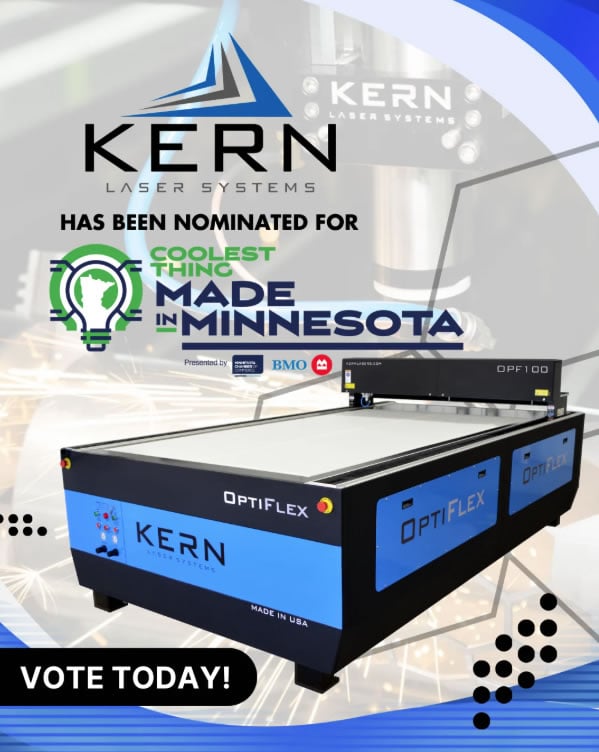
The beam quality of a fiber laser is generally superior. It can be focused to a much smaller spot size, allowing for finer detail and faster cutting speeds on thin to medium metals. CO₂ lasers, while powerful, have a larger spot size and require more complex optical paths. This complexity can lead to higher maintenance needs over time. Kern Laser Systems has long recognized the value of precision engineering, offering systems like the OptiFlex for versatile CO₂ applications and the FiberCELL for pure metal cutting.
Material Compatibility and Applications
The choice between these technologies often hinges on the materials you process daily. CO₂ lasers are renowned for their versatility across organic materials and light gauge metals. They cut acrylic, wood, leather, foam and thin mild steel with exceptional edge quality. This makes them the preferred choice for signage, advertising displays, and craft industries. If your business relies heavily on engraving awards or cutting preprinted materials, a CO₂ system is likely your best option.
However, when it comes to metals, fiber lasers dominate. They are highly efficient at cutting reflective metals like copper, brass, and aluminum, which can be challenging for CO₂ lasers. Fiber lasers also excel at cutting thick steel plates with greater speed and lower gas consumption. For shops focused on industrial fabrication, aerospace components, or automotive parts, the fiber laser is the superior tool. You can explore more about laser applications and materials to see how these technologies apply to your specific needs.
Maintenance Procedures
Although CO₂ and fiber lasers use different technologies to generate the laser beam, they share many of the same routine maintenance requirements and benefit from regular inspection and preventative care.
Both systems require regular inspection and cleaning of mirrors and lenses to ensure optimal beam quality and cutting performance. A sacrificial window is installed on CO₂ and fiber laser systems to protect the laser source and beam delivery optics from contamination and back reflections. On CO₂ laser systems, the sacrificial window is made of potassium chloride (KCl) or zinc selenide (ZnSe), while fiber laser systems use synthetic fused silica (quartz). Replacing the sacrificial window on a CO₂ laser requires removing the lens assembly. In contrast, fiber laser systems feature a convenient push-to-open drawer that provides quick and easy access for window replacement, minimizing maintenance time.
Maintenance of the water chiller, including monitoring coolant levels and replacing chiller fluids and filters according to the manufacturer’s recommendations, is essential for reliable temperature control, flow rate and laser source longevity.
In addition, bearings and other moving components should be lubricated on a regular schedule to minimize wear, reduce friction, and ensure smooth machine operation. Performing these routine maintenance tasks consistently helps maximize cutting quality, improve reliability, and extend the service life of both CO₂ and fiber laser systems.
The primary difference between CO₂ and fiber laser source maintenance lies in the replacement process for a defective laser source. To minimize downtime, Kern maintains an inventory of replacement laser sources through its Advanced Replacement Program, ensuring a compatible unit is readily available whenever service or replacement is required. This approach is especially valuable in high-production environments where maximizing machine uptime is critical.
CO₂ laser sources are generally straightforward to replace, and Kern provides customers with detailed, step-by-step instructional videos to guide the process. In contrast, replacing a fiber laser source is more complex because the fiber processing head and beam delivery cable are typically replaced at the same time. These components require careful handling and installation in a clean environment, making on-site service by a trained technician the recommended approach. Following installation, both CO₂ and fiber laser systems require beam alignment and focus verification to ensure the laser is properly calibrated for optimal performance and processing accuracy.
Machine Enclosures and Safety
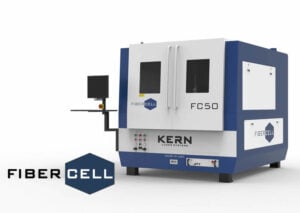 One important consideration when choosing between a CO₂ and fiber laser system is the machine enclosure. Kern offers CO₂ laser systems in both open-bed (Class 4) and fully enclosed (Class 2) configurations, giving customers the flexibility to select the design that best fits their workflow and safety requirements. Fiber laser systems, however, are available only in a fully enclosed (Class 2) configuration to provide a more controlled environment for metal processing and to reduce the risk of a reflection from the 1-micron wavelength fiber laser. An open-bed CO₂ system can simplify loading and unloading large sheets or oversized parts and offers greater accessibility for certain applications. In contrast, a fully enclosed system provides an additional layer of operator protection and may better align with workplace safety policies or facility requirements. Depending on your production environment, material handling needs, and safety priorities, enclosure style can be an important factor in determining which laser system is the best fit.
Space Requirements
The overall footprint difference between open-bed and enclosed laser systems is generally minimal. However, when comparing systems with the same work area, an enclosed model is typically 1–2 feet wider and longer to accommodate the safety enclosure. If your shop has limited floor space, the additional footprint of an enclosed system may be an important consideration when selecting the right laser system.
In addition to the CNC system, peripheral equipment such as chillers, vacuum blowers, and cutting gas cylinders may be required. Be sure to account for these components when planning your shop layout, as they require additional floor space for proper installation and operation.
Total Investment
From an investment standpoint, Kern’s CO₂ and fiber laser systems are also similarly priced when comparing equivalent machine work areas and laser power configurations. As a result, overall machine cost is rarely the deciding factors.
Key Takeaways
Choosing the right laser cutting machine is a significant decision that impacts your production capabilities and profitability. Whether you need the versatility of a CO₂ system for non-metals or the power of a fiber laser for metals, Kern Laser Systems has the expertise to guide you.
While total investment, space requirements, and routine maintenance are all important considerations, they are typically not the primary factors when choosing between a CO₂ and fiber laser system. In most cases, the decision should be driven by the materials you process, the applications you perform, and the workflow and safety requirements of your facility. Selecting the laser technology that best matches your production needs will have a far greater impact on productivity, operating efficiency, and long-term return on investment than relatively small differences in machine footprint, maintenance procedures, or purchase price.
If you’re still unsure which laser technology is the best fit for your application, Kern Laser Systems offers a complimentary sample processing program to help you make an informed decision. Simply send us your material and cutting file, and our applications team will process your parts on CO₂ and fiber laser systems, when appropriate, to evaluate the results. We’ll then provide expert recommendations based on your material, application, performance expectations, and production goals, giving you the confidence to choose the right solution, all at no cost.